Assessing Offensive Efficiency in a War of Attrition
Is 2026 Really Yielding Underwhelming Results?

The apparent slowdown of Russian territorial gains in 2026 has encouraged the interpretation that Moscow’s offensive effort is producing underwhelming results. This reading is incomplete. In a war of attrition, offensive performance cannot be measured by territorial gains alone. It must be assessed through the relationship between ground captured, losses sustained, losses imposed, and the operational value of the sectors being contested.
In the current information warfare context, it has become increasingly difficult to produce a reliable analytical assessment of the Russian offensive ongoing since late 2023. In order to determine whether 2026 is genuinely showing signs of falling behind previous years, indices remain one of the most relevant tool available for strategic analysis.
Territorial maps remain useful, but they are increasingly insufficient as a measure of offensive performance. They tend to privilege visible advances over attritional effects, lag behind tactical realities in contested grey zones, and obscure the distinction between secondary skirmish sectors and the main operational effort. This is particularly problematic in 2026, where the apparent reduction in the pace of advance does not necessarily imply a reduction in offensive efficiency.
The Russian Offensive Efficiency Index
The following Russian Offensive Efficiency Index was conceived as a composite of the following key military dimensions in attrition warfare:
personnel loss ratio per captured km²;
armour loss ratio per captured km².
The use of loss ratios enables the model to abstract from the incompleteness of available data sources, especially in 2026. The lower the total, the more efficient the offensive. The index should therefore be read as a measure of relative offensive efficiency, not as a comprehensive measure of strategic success. A lower value indicates that Russian forces are generating territorial effects at a lower relative cost.
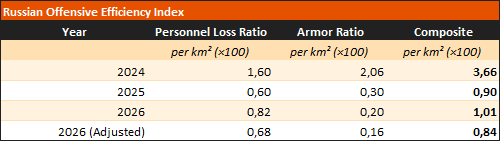
The model uses controlled territory at full weight and grey-zone territory at half weight. For 2026, two variants are used: a standard DeepState-based model and an adjusted model accounting for observable mapping delays, geolocated Russian presence, deeper assault-group movement, and mapping anomalies.
The results are revealing. The index demonstrates that 2025, at 0.90, saw a multiple-fold improvement compared with 2024, at 3.66, a year in which Russian personnel fatalities peaked, likely caused by the intense use of armoured columns. The change of tactics in subsequent years shifted this balance, while the operational situation created by the collapse of the Sudzha pocket offered opportunities for more rapid advances and faster depletion of Ukrainian reserves by autumn of 2025.
So where does 2026 stand? Beyond the distortion of information observed and the undeniable improvements of Ukrainian forces, described at length in a previous article, the index remains extremely close to 2025, at 1.01.
Nevertheless, the captured-terrain dimension, which is a central argument, requires adjustment to account for significant Russian progress in controlled territory and grey zones currently absent from DeepState’s baseline mapping. This results in a significantly improved index of 0.84, indicating that the doctrinal changes introduced by Russian command since the beginning of the year, though yielding less aggressive advances, have had a positive impact on the attrition tempo caused by the ongoing offensive effort.
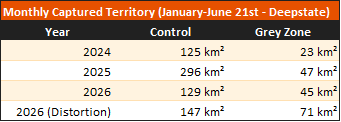
This complicates claims that Ukraine has taken back the strategic initiative in the conflict. In fact, it confirms previous conclusions that the more aggressive Ukrainian defensive posture, illustrated by the adoption of Russian small-assault-group tactics to contest secondary directions, is generating heavy attrition ratios in almost every category of assets and personnel.
The index therefore raises a second question. If Russian territorial gains appear less dramatic than in 2025, why has offensive efficiency not deteriorated in the same proportion? The answer lies in the changing structure of the front.
The Operational Rationale and Implications of the Index
It has become necessary to point out that the frontline is now split into two types of directions until autumn:
Skirmish battles: the secondary directions of Zaporizhzhia, Kupyansk, Pokrovsk, and the buffer zones of Kharkiv and Sumy oblasts;
Offensive effort: the primary push to establish siege lines around the Sloviansk-Kramatorsk agglomeration.
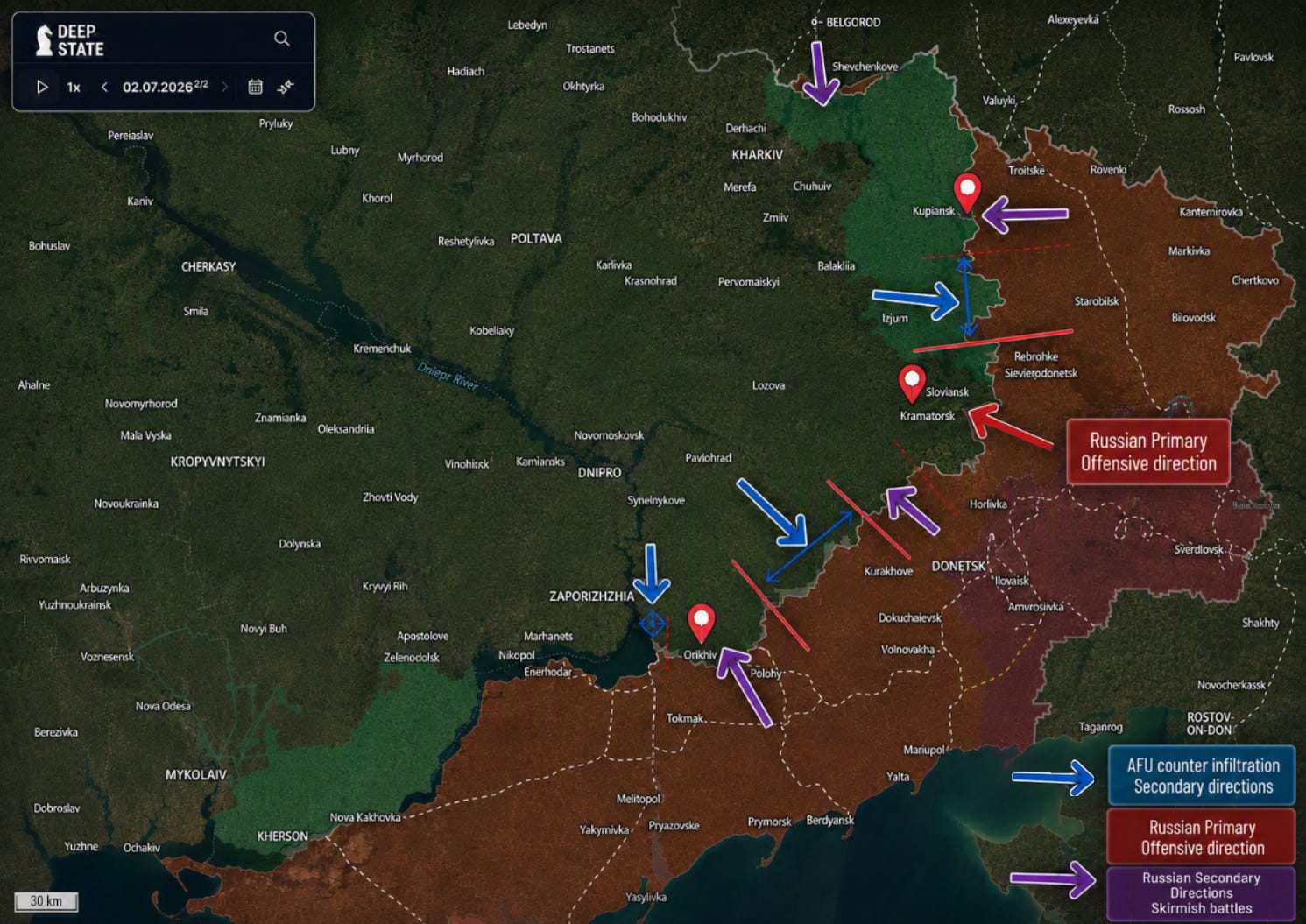
The secondary directions are the site of skirmish clashes between both sides. In some sectors, Russian forces are pushing, while in others, Ukrainian forces are attempting to dislodge them from weak points of secondary importance.
Light assault groups progress between defensive positions to gradually establish waypoints and layered routes into the rear of defensive formations. They reconnoitre supply and rotation routes, drone-unit locations, and reaction-force staging areas, which are then targeted by pre-positioned artillery with firing plans when movement is detected, or flattened by FAB air strikes.
Flag-raising events contribute to this tactical doctrine by forcing Ukrainian reactions to re-enter settlements, which are then observed either by drones or by special forces in hiding. In effect, the goal is less to advance rapidly than to disrupt the Ukrainian deployment, push back observation points and drone units, and pave the way for heavier formations to advance at a later stage.
Over time, this also causes severe attrition to defending units, which translates into the almost on-par casualty ratio observed in OSINT data from Mediazona (4,880 KIA) and UALosses (5,820 KIA once factoring dateless records) to date. If both outlets treatment speed is considered equivalent; it would point toward higher Ukrainian casualties in 2026.
At the edge of those directions, and between Combined Arms Army areas of responsibility, the AFU has been conducting local counter-infiltration operations, mainly around Stepnohirsk, Komar, and Ridkodub. This approach appears to be an adoption of Russian assault tactics.
Based on available footage, it has enabled the reclaiming of a few villages, while several others are contested, for a total area of about 100 km² moved into the grey zone since February. There is, however, little evidence on the ground that firm control has been established.
The fact that these attempts are concentrated in quadrants of low importance to the Russian primary effort, lightly defended and with Russian forces not appearing to rush additional troops to reinforce, mass bombard the areas or react decisively otherwise, points towards a clear decision to let Ukrainian assault units suffer losses for meagre gains. Attrition will ensue.
The hypothesis that Russian command is simply out of troops and cannot respond would be relevant if units had been transferred from other directions to plug gaps or progress in the primary direction had stalled. So far, however, no such move has been recorded, and offensive efforts have not discontinued along the line. It is nonetheless indicative of the low force density in this war: with allegedly 700,000 troops in Ukraine, a third of which are first line units, Russian forces are unable to both concentrate forces toward North Donetsk and heavily man every other direction.
The Primary Direction: Sloviansk-Kramatorsk
In the primary direction, a derivative of those tactics has been adopted, with the aim of making significant advances directly towards the main goal of this phase of military operations: Sloviansk and Kramatorsk.
This is where most Russian gains have occurred, and where maps are about two months late. Kryva Luka and Kalenky, in the Sloviansk direction, were marked as captured by DeepState in late June and July, but flags were raised in March and during the first week of May.
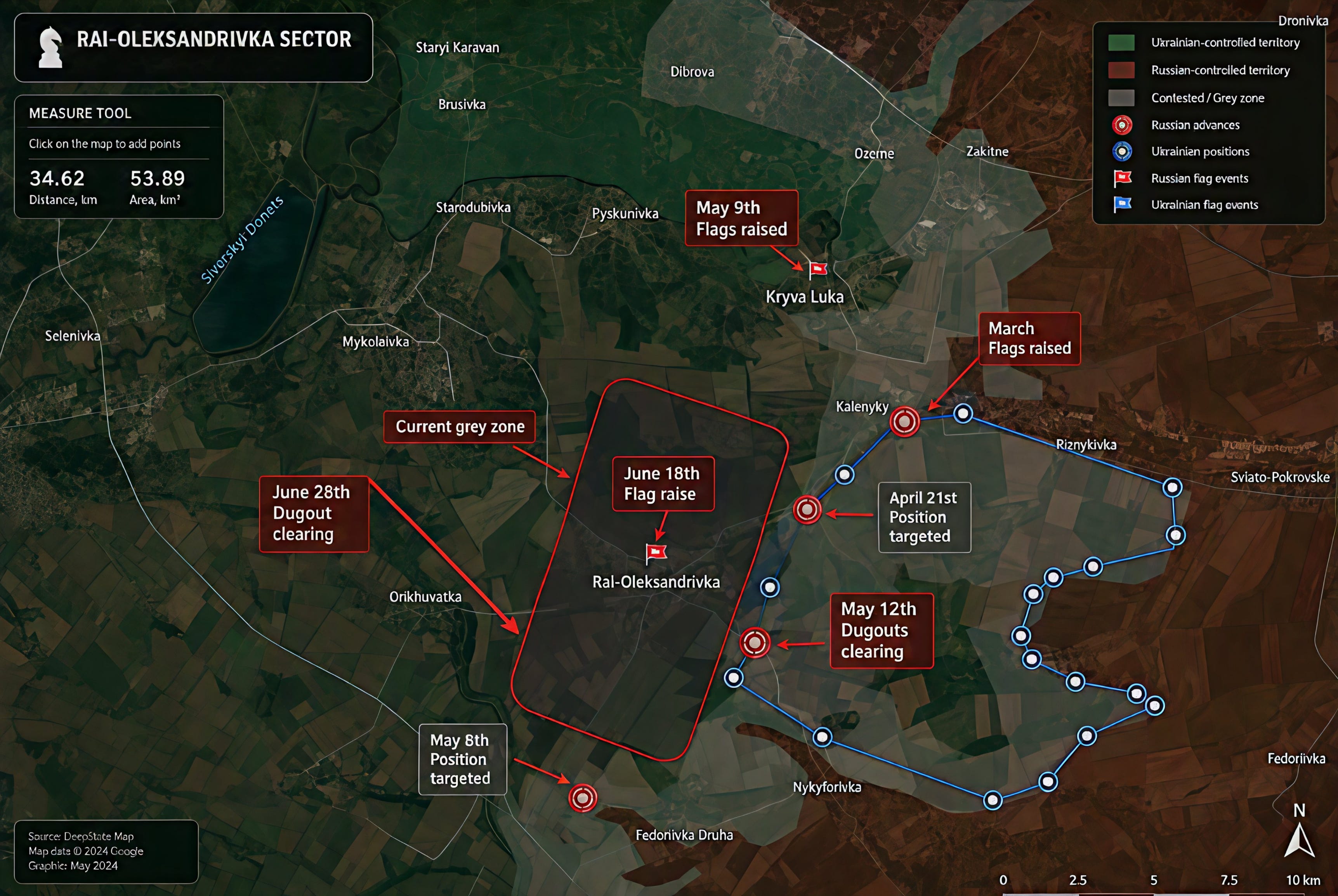
The model could increase the weight of territorial gains there, but for simplicity, not in this version.
The severe vehicle attrition observed can be explained by the constrained logistical routes into the agglomeration, as well as into the besieged city of Kostiantynivka. Once more, defenders find themselves in complex dispositions, dependent on one major axis for supplies. As Russian units and artillery approach, this will further increase the observed imbalance.
Regular armour asset-loss analysis shows that, after the catastrophic losses of 2025, which can be explained by the collapse of the Sudzha pocket and the Pokrovsk cauldron, 2026 shows a slight decrease in Ukrainian losses. Unlike Russian losses, however, they are not at their lowest level since the start of the war, but rather back to 2024 levels, around 1,500 annually if projected.
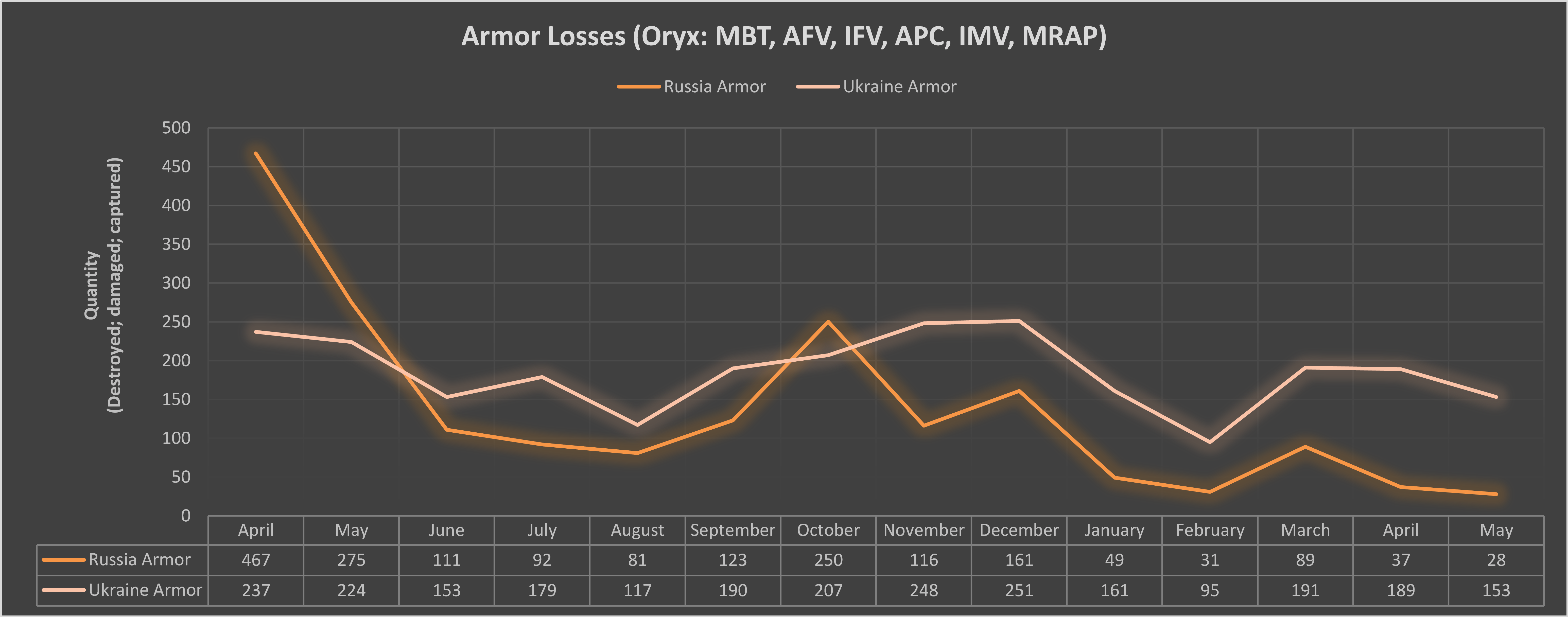
With the heavy armour fleet having suffered extremely heavy attrition, half of the losses are now lighter armoured vehicles, such as infantry mobility vehicles, which the AFU has in significant numbers and can produce locally. Therefore, despite the ongoing de-mechanisation, Ukrainian forces still lose significantly more assets, of all types, in their defensive effort.
The improvement of the index since 2025 reflects the efficiency of Russian doctrinal changes to adapt to drones and other technological advancements.
In a way, Russian command is accepting minor territorial losses in irrelevant directions to preserve its offensive potential towards the only decisive operational area in Donbas, where it is making gradual and significant gains. At the same time, in crucial secondary directions, it is conducting an intense skirmish battle aimed at long-term benefits, particularly in relation to the future breaching of new defensive lines in the open terrain beyond Zaporizhzhia and Dnipropetrovsk oblast.
The concentration of effort is clearly reflected in the index levels, which incidentally demonstrates the limits of territorial gains as a measure of offensive performance.
Methodology
Territorial data is modelled by weighting controlled territory as 1 and grey-zone territory as 0.5. Recent mapping changes aside, the grey zone, as explained above, is now where the skirmish battle unfolds. It therefore matters at the operational level.
Two models using DeepState data are used for 2026:
Standard gains: directly using DeepState information;
Distortion adjustment: obvious delays in updates from the DeepState map do not enable a fully comparative assessment with previous years. A per-sector adjustment has been created to account for this gap and provide a ratio with the same reliability as earlier years.
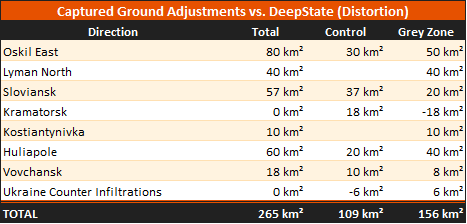
Everything is based on geolocations, evident movement of assault groups deeper into Ukrainian positions, or mapping anomalies. Refer to the other analysis for specific sector details and to the attached table for the proposed changes:

Overall, 2026 weighted gains are somewhat above 2024 but fall far below 2025 levels. Nevertheless, attrition has improved.
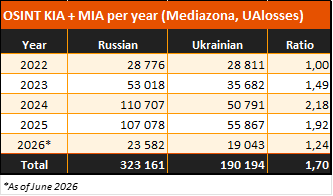
The human-loss index leverages available data on fatalities and missing-in-action cases, reconstructed from reliable OSINT sources, as of June 22nd 2026. Russian MIA figures are based on the current flow of court cases recognising missing soldiers as casualties, distributed with the majority of the weight in 2025 and 2026.
Ukrainian losses are based on the latest UALosses data release. The use of ratios mitigates the incompleteness of databases and removes the need to model total losses. The table summarising the data used confirms that, following a costly 2024, the gap is tightening between both sides.
The armour-loss index comes in two versions: all-inclusive and heavy armour only. It relies on Oryx data.
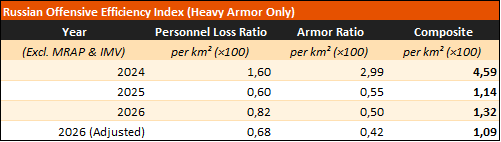
The correlation between human casualties, armoured losses, and territorial gains becomes interesting in 2026, a year in which, without using armoured vehicles at comparable levels, Russian forces are able to perform better than in 2024.
Moscow’s doctrinal adaptation is interesting in the sense that it enables less costly progress through some of the most fortified sectors of the front while attriting Ukrainian forces favourably. The application of Svechin’s principle of endurance in war is what the index principally demonstrates.
Caveats: A few caveats are necessary.
First, other assets such as artillery are not included. The reason is that the ratio has likewise been favourable to Russia since 2025 and does not affect the current levels of the index in any way that would improve interpretation.
Second, civilian vehicles, from cars to motorbikes and scooters, are largely irrelevant to the war of attrition. Beyond the cost of procuring them, which is negligible compared with armour, they can be purchased on a vast global second-hand (40m units in Asia only every year) and new-vehicle market. The quantities lost in this conflict are anecdotal compared with what can be easily supplied to armed forces.
Moreover, there is no comparable and reliable data on these items, meaning any ratio would be biased or unusable. Overall, it is assessed that both sides suffer significant such losses in comparable amounts. Personnel casualties incurred during their destruction are already covered in the index.
Third, the impact of mid-range strikes on Russian logistics is not modelled separately. Both sides are waging a massive campaign in the 50–200 km band from the frontline. Effects are inherently tied to the ability to pursue combat operations. Therefore, there is no need to model them separately within the index.
For instance, if Russian forces were suffering from major supply issues, artillery would go silent, Rubicon would not be able to operate and inflict growing month-on-month losses, and both primary and secondary directions would falter. The same logic is valid for the Ukrainian side. All of this is directly incorporated in the index through loss ratios and km² gained. Lower supplies basically imply decreased operational tempo.
Conclusion
The index does not support the argument that 2026 is producing a fundamentally underwhelming Russian offensive performance. On the contrary, once mapping distortion and grey-zone dynamics are taken into account, the Russian offensive appears broadly consistent with, and in some respects more efficient than, the 2025 pattern.
This does not mean that Russian advances are spectacular, nor that Ukrainian forces have failed to adapt. It means that territorial gain alone is a poor measure of offensive efficiency in a war of attrition. The more relevant question is whether an army can continue to impose losses, preserve its own offensive potential, and gradually improve its positional situation in the decisive sectors of the front.
On that basis, the Russian effort in 2026 appears less dramatic than in previous phases, but not less effective. Its logic is increasingly one of operational endurance: accepting limited local reverses, avoiding costly mechanised thrusts where possible, and concentrating the decisive effort where the strategic payoff is highest. That, more than raw kilometres gained, is what the index captures.
How those operational changes were forced by Ukraine’s more robust posture this year is hard to tell. Nevertheless, it does not seem the focal point has been reached or that the war can be decided in the coming months.
Bonjour,
Un angle d’analyse très intéressant qui va au delà de la quantification du moindre échange de m², qui, dans ce conflit, apparaît comme une unité de mesure trop simpliste…
Excellent analysis. Do you have any idea of current and future projected recruitment levels on both sides? How many men does UKR forcibly conscript? It seems that brutal methods as reported by @Events in Ukraine have significantly reduced desertion numbers. Russia does seem to have more difficulty maintaining recruitment levels and may be resorting to forced conscription in some locations.